
 01
01Activity changes
Classic psychedelics change how brain activity is organized.
 02
02Experience changes
Perception, emotion and familiar ways of thinking may feel different.
 03
03Benefit is a separate question
A changed brain measurement or intense experience does not guarantee helpful change.
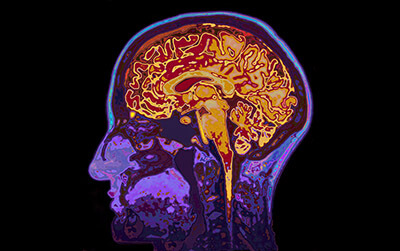
Illustrative image, not a before-and-after scan.
Evidence reviewed: September 27, 2026.
You may have heard that psychedelics reset the brain, switch off the ego, or lay down new pathways. These explanations are memorable. They also make the science sound more settled than it is.
There is a useful explanation taking shape. Classic psychedelics temporarily change how brain activity is organized. Familiar ways of perceiving and making sense of things may become less dominant. That can feel freeing, confusing, beautiful or frightening. Whether it leads to a helpful change is a separate question.
We take these findings seriously, while leaving room to change our explanation as the evidence develops.
Start with the receptor
Psilocybin becomes psilocin in the body. Psilocin, LSD and DMT activate a serotonin receptor called 5-HT2A. A receptor is a protein that responds to chemical signals and changes what a cell does. Human studies relating receptor occupancy to experience, and experiments blocking the receptor, make this one of the firmer parts of the explanation. Madsen et al. (2019); Preller et al. (2018).
Entheo has used the image of a key fitting a lock. It works as a starting point. But a brain cell has many “locks,” a drug can affect several, and activating one changes activity in a larger living system. Serotonin is not simply a happiness chemical. A receptor does not contain a memory, an insight or a treatment outcome. Neural mechanisms review (2022).
Usual boundaries become less fixed
Brain networks are groups of regions whose activity tends to vary together. Under classic psychedelics, some networks become less separate. A large 2026 analysis pooling 11 datasets found a shared increase in coupling between association systems and sensory systems. Reductions within networks were less uniform. This is more specific than saying that everything connects to everything. Network mega-analysis (2026).
The default mode network, or DMN, participates in remembering, imagining and thinking about ourselves and others. It is part of this wider reorganization. It does not switch off, and it is not a single ego centre. A changed sense of self cannot be reduced to one region going quiet. Doss et al. (2022).
“Connectivity” needs care, too. In most of these studies it means a statistical relationship between signals, not new anatomical wiring. Functional MRI measures blood-oxygen changes indirectly related to neural activity. Blood-vessel effects can complicate the picture; a 2025 study demonstrated this particularly clearly in mice. EEG and MEG offer complementary measurements. A colourful scan is not a direct picture of a thought. Neurovascular study (2025).
Why might old patterns feel less convincing?
Predictive-processing theories describe the brain as continually interpreting incoming information using what it already expects. Those expectations operate at different levels, from interpreting a sound to making sense of who we are. A “prior” is an existing expectation; its “precision” is the weight the system gives it.
Robin Carhart-Harris and Karl Friston’s REBUS model proposes that psychedelics reduce the grip of some high-level expectations, allowing other information more influence. An entrenched view such as “nothing can change” might become easier to examine. This is a plausible account, not a scan showing a particular belief loosen. Carhart-Harris & Friston (2019).
There are competing and complementary accounts. Some hallucination models emphasize stronger expectations at certain processing levels. Thalamic models focus on altered routing and filtering of information; claustrum models focus on coordination across the cortex. LSD studies support specific thalamic changes, but not a simple sensory floodgate opening. These models may describe different parts of the same process. None explains the whole experience. Neural mechanisms review (2022); Preller et al. (2019); Doss et al. (2022).
More possibilities does not mean more wisdom
The entropic brain hypothesis, developed by Carhart-Harris and colleagues, links a wider range of possible experiences to more varied brain activity. Several EEG and MEG studies support increased signal diversity during psychedelic states. Here, entropy concerns the unpredictability or diversity of measured signals. It is not a score for insight or mental health. Carhart-Harris et al. (2014); Schartner et al. (2017).
Related work asks whether brain dynamics move towards “criticality”: a proposed boundary between overly stable and overly disorderly activity. That is an interesting mathematical description, with findings dependent on the measure and model. It is not an established optimal state everyone should seek. The broader theory of consciousness remains open to debate. Carhart-Harris (2026).
Nor is the experience merely random noise. A 2026 psilocybin study using both fMRI and EEG found patterns organized by context, including music, meditation and a movie. It offers a refinement: less familiar organization can coexist with new structure. Its open-label design and associations with next-day mindset do not prove a treatment mechanism. Stoliker et al. (2026).
Feelings, memories and the sense of self
A memory may feel closer. An emotion may become easier to approach, or much harder to contain. Changes in emotional processing involve interacting systems, not an amygdala “fear switch.” Studies differ by substance, task and whether measurements occur during the experience or afterward. BMJ evidence review (2026); Doss et al. (2023).
A powerful sense of knowing deserves curiosity, but also patience. Vividness and conviction do not establish that a remembered event happened exactly as it appears. Laboratory research with MDMA has found impaired emotional recollection under some conditions. That does not tell us the truth or falsity of a particular memory. It does challenge the idea of a drug unlocking an accurate recording of the past. A separate controlled study with psilocybin and 2C-B found altered encoding of episodic familiarity. These laboratory tasks are not tests of someone’s life story. Doss et al. (2018); Doss et al. (2024).
Psychological flexibility means being able to respond differently when an old response is no longer useful. It is not interchangeable with neural signal diversity. In a small psilocybin study in depression, performance on a cognitive flexibility task improved, but that improvement did not track the improvement in depression. Moving between ideas, changing behaviour and feeling better are related questions, not the same measurement. Doss et al. (2021).
01Measured activity
Scans can show relationships between brain signals.
 02
02Physical changes
A change in those signals is not proof that new connections grew.
 03
03Personal benefit
Neither measurement proves that an experience will help a particular person.
Does the brain become more plastic?
Plasticity is the nervous system’s capacity to change. In mice, researchers have directly observed new and enlarged dendritic spines after psilocybin. Other animal studies found changes in the ability to learn social rewards. These are meaningful findings in particular experimental systems. They are not photographs of new connections forming in a person after a journey. Shao et al. (2021); Nardou et al. (2023).
The human evidence is developing. A 2026 study found changes in diffusion MRI a month after psilocybin. These indirect measurements cannot identify new synapses, and the exploratory, fixed-order design limits causal conclusions. Another small study used PET to measure a synaptic protein marker one week afterward: it found no statistically significant overall increase. Neither result settles the question. Lyons et al. (2026); Johansen et al. (2026).
Scientists also disagree about which cellular pathways are necessary. Work on intracellular 5-HT2A receptors and the growth-factor receptor TrkB offers different preclinical accounts. We do not yet have a verified chain from receptor activation to human synaptic change to recovery. Vargas et al. (2023); Moliner et al. (2023).
What about a window for change?
The acute state and what follows should be kept separate. Most dramatic brain changes are measured while the drug is active. Some studies find more selective changes afterward; their duration and meaning vary. A small study with repeated scans found persistent changes involving the hippocampus and DMN, not a permanently reorganized whole brain. Siegel et al. (2024).
We have described fresh snow covering deeply rutted ski tracks. It can convey the feeling that familiar routes are less compulsory. That is where the metaphor stops: memories are not erased, new tracks are not automatically better, and we cannot give everyone a biological deadline for integration.
Preparation, relationships and surroundings may influence the experience. Reflection and practical support afterward can help someone decide what, if anything, to do with it. The precise contribution of integration, and the best form or timing, remain insufficiently established. A difficult outcome is not proof that someone failed to surrender or integrate properly. Carhart-Harris et al. (2018); BMJ evidence review (2026).
The substance still matters
Psilocybin, LSD and DMT share important receptor effects, but differ in duration and pharmacology. MDMA primarily promotes release of serotonin, norepinephrine and dopamine through transporters; its social and emotional effects need a separate explanation. Ketamine primarily acts at NMDA receptors. Ayahuasca includes MAO inhibitors as well as DMT. One brain story cannot establish the benefits or medication safety of all of them. MDMA pharmacology review (2025); Neural mechanisms review (2022); Lima da Cruz et al. (2024).
What this means for you
Some brain changes correlate with clinical improvement. Correlation does not show that a particular change caused recovery, or that a more intense experience would help more. Drug effects, expectations and psychological support are difficult to disentangle in trials. Daws et al. (2022); BMJ evidence review (2026).
Psychedelics may create an opportunity to examine patterns and make changes. They do not reliably make those changes for us. Start with preparation, understand your health considerations, and give yourself time for reflection, meaning-making and action afterward. You do not need to turn every striking experience into a conclusion.
For the full source list and explanation of the different theories, visit Basic Psychedelic Neuroscience.
Sources and further reading
- Madsen et al. (2019). Psychedelic effects of psilocybin correlate with serotonin 2A receptor occupancy and plasma psilocin levels
- Preller et al. (2018). Changes in global and thalamic brain connectivity in LSD-induced altered states of consciousness are attributable to the 5-HT2A receptor
- The neural basis of psychedelic action (2022)
- An international mega-analysis of psychedelic drug effects on brain circuit function (2026)
- Doss et al. (2022). Models of psychedelic drug action: modulation of cortical-subcortical circuits
- Psychedelic 5-HT2A receptor agonism alters neurovascular coupling and differentially affects neuronal and hemodynamic measures of brain function (2025)
- Carhart-Harris & Friston (2019). REBUS and the Anarchic Brain
- Preller et al. (2019). Effective connectivity changes in LSD-induced altered states of consciousness in humans
- Carhart-Harris et al. (2014). The entropic brain: a theory of conscious states informed by neuroimaging research with psychedelic drugs
- Schartner et al. (2017). Increased spontaneous MEG signal diversity for psychoactive doses of ketamine, LSD and psilocybin
- Carhart-Harris (2026). The entropic brain today
- Stoliker et al. (2026). Psychedelics align brain activity with context
- Psychedelic medicine: mechanisms, evidence, and translation to practice (2026)
- Doss et al. (2023). The acute effects of psychoactive drugs on emotional episodic memory encoding, consolidation, and retrieval: A comprehensive review
- Doss et al. (2018). MDMA impairs both the encoding and retrieval of emotional recollections
- Doss et al. (2024). Psilocybin and 2C-B at Encoding Distort Episodic Familiarity
- Doss et al. (2021). Psilocybin therapy increases cognitive and neural flexibility in patients with major depressive disorder
- Shao et al. (2021). Psilocybin induces rapid and persistent growth of dendritic spines in frontal cortex in vivo
- Nardou et al. (2023). Psychedelics reopen the social reward learning critical period
- Lyons et al. (2026). Human brain changes after first psilocybin use
- Johansen et al. (2026). Psilocybin’s effect on human brain synaptic plasticity
- Vargas et al. (2023). Psychedelics promote neuroplasticity through the activation of intracellular 5-HT2A receptors
- Moliner et al. (2023). Psychedelics promote plasticity by directly binding to BDNF receptor TrkB
- Siegel et al. (2024). Psilocybin desynchronizes the human brain
- Carhart-Harris et al. (2018). Psychedelics and the essential importance of context
- Ecstasy, molly, MDMA: What health practitioners need to know about this common recreational drug (2025)
- Lima da Cruz et al. (2024). Effects of psychedelics on neurogenesis and broader neuroplasticity: a systematic review
- Daws et al. (2022). Increased global integration in the brain after psilocybin therapy for depression